Cart
0
Most people in India replace their wiper blades the same way: the first heavy shower of the season turns the windshield into a smeared mess, and they buy a new pair that afternoon. It works, but it means driving through the worst visibility of the year on blades that were already finished.
Wiper blades here don't wear out the way they do in Europe or North America. They fail from dust and heat long before they fail from use. Understanding that changes both how long yours last and when you should be replacing them.
How long do wiper blades actually last in India?
Six to twelve months is a realistic window for most Indian cars. That is shorter than the one-to-two years often quoted internationally, and the reason has little to do with how much you drive.
Rubber degrades under ultraviolet light and heat. A car parked in the open in Delhi, Jaipur or Ahmedabad through May and June sits under surface temperatures well above anything a blade in a temperate climate ever sees. The rubber hardens, loses its flexibility, and stops conforming to the curve of the glass. A car that covers 5,000 km a year parked in the open will often need blades sooner than one covering 20,000 km parked in a basement.
The practical takeaway: replace on a calendar, not on a kilometre reading, and do it before the monsoon rather than during it.
Five signs your wiper blades need replacing
- Streaking — thin lines of water left behind on each pass, usually meaning the rubber edge has torn or hardened.
- Chattering or juddering — the blade skips across the glass in stages instead of gliding, often with a shudder through the arm.
- Skipped patches — sections of the sweep the blade never properly contacts, typically caused by a permanently curved, set-hard blade.
- Squealing — noise on a wet screen points to a hardened edge, not a dry one.
- A hazy band — a fine film left across the swept area that catches headlight glare at night.
Night driving in rain is where worn blades stop being an annoyance and start being a safety problem. Oncoming headlights refract through the smeared film and wash out the whole windshield.
The habit that destroys blades fastest
Running the wipers on dry, dusty glass.
This is the single most damaging thing you can do to a wiper blade, and it is close to universal on Indian roads. A car parked overnight collects a fine layer of road dust. Switch the wipers on to clear it and the blade drags that grit across the glass under spring pressure — the rubber edge is doing the work of sandpaper against itself. A few weeks of this rounds off the precision edge that makes a blade wipe cleanly at all.
The fix costs nothing: always wet the glass before the blade moves. Use the washer jets, let the fluid spread, then wipe. If the screen is caked in dust or the car has been standing for days, rinse it with water or wipe it down by hand first.
The same applies to bird droppings, tree sap and mud. Lift the arm and clean those off by hand. Dragging a blade over dried droppings will tear the rubber in one pass.
What goes in the washer reservoir matters
Plain water is what most reservoirs in India contain, and it is a poor choice for two reasons. It does not cut the oily film that traffic exhaust deposits on a windshield, and it does not lift insect residue at all — so the wiper ends up smearing rather than clearing. In hard-water regions, which covers most of northern India, dissolved minerals also build up as scale inside the washer jets and slowly choke the spray pattern.
Detergent and dish soap are worse. They are not formulated for automotive use, they strip the plasticisers out of wiper rubber, and they can attack paint, trim and rubber seals over time.
A proper washer fluid is the answer. The MICHELIN Windshield Washer Concentrate is a 1:100 concentrate, so a 500 ml bottle makes a substantial amount of fluid, and it is formulated to be safe on wiper rubber and on all automotive glass including tinted windows.
Cleaning and maintaining the blades themselves
Two habits, both quick:
Wipe the rubber edge every couple of weeks. Fold the arm away from the glass, take a damp microfibre cloth, and draw it along the length of the blade. You will usually see a grey streak come off — that is embedded grit that would otherwise be scoring your windshield on every wipe. A clean microfibre towel is the right tool here; a paper towel or old rag can leave lint or snag the edge.
Keep the glass genuinely clean. Wax, polish overspray and traffic film all cause juddering, and a new blade on a contaminated windshield will judder exactly like the old one did. If blades chatter immediately after replacement, clean the glass properly before assuming the blades are faulty.
When parking in open sun for long stretches, a windshield sunshade or cover protects the blades along with the dashboard. Shade is better than either.
Choosing a replacement: traditional or flat blade
Two designs cover almost every car on Indian roads.
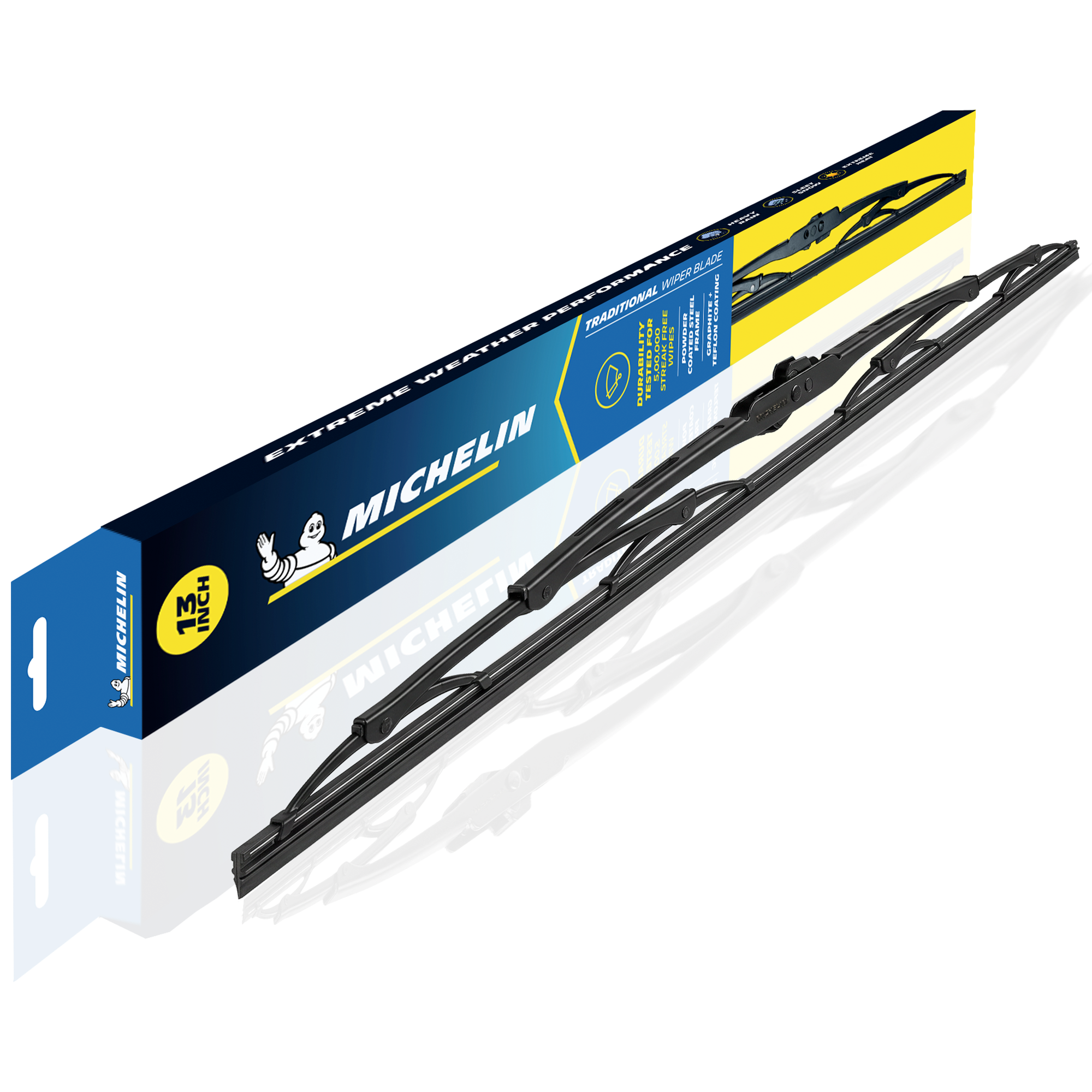
Traditional frame blades use a metal frame with several pivot points to spread pressure across the blade. They are the long-standing design, they are inexpensive, and they suit most hatchbacks and sedans. The MICHELIN Traditional Wiper uses graphite and Teflon-treated rubber, which reduces friction against the glass — the practical effect is a quieter, smoother wipe and less chatter.
Flat blades, also called beam blades, replace the frame with a single curved high-carbon steel strip that presses the rubber against the glass along its whole length. That matters more on modern, strongly curved windshields, and there is no frame to catch wind at highway speed. The MICHELIN Flat Blade Wiper pairs that steel strip with natural rubber.
Neither is universally correct. Flat blades cost more and suit newer cars with curved screens; traditional blades remain a sound choice for older and more affordable models.
Getting the size right
Two things catch people out.
First, the driver and passenger blades on most Indian cars are different lengths — a 24-inch driver's side paired with a 16-inch passenger side is a common pattern. Buying two of the same length is one of the most frequent mistakes.
Second, replace both together. They have been exposed to identical heat and dust and have worn at the same rate, so replacing one leaves you with mismatched contact and a clean sweep on only half the screen.
To find your sizes, measure each existing blade end to end, or check the owner's manual. Michelin blades run from 10 to 26 inches, covering effectively every passenger car sold in India. Browse the full range on the Michelin wiper blades collection.
One more check: if brand-new blades still streak, the problem is likely the wiper arm, not the blade. A bent arm or a weakened spring cannot hold the blade flat against the glass, and no replacement blade will compensate for that.
Don't overlook the rear wiper
Rear wipers on hatchbacks and SUVs get used a fraction as often as the front pair, which leads most owners to assume they last indefinitely. They don't. Rubber ages whether it is being used or not, so a rear blade sitting untouched for two years in the sun hardens and cracks exactly like a front blade — it just does so unnoticed until the first time you reverse in heavy rain.
Check it on the same schedule as the front blades.
The short version
- Replace every 6–12 months, and do it before the monsoon rather than during it.
- Never run the wipers on dry or dusty glass — wet the screen first, every time.
- Use a proper washer fluid, never plain water and never detergent.
- Wipe the rubber edge with a damp microfibre every couple of weeks.
- Replace blades in pairs, and check that you have the right length for each side.
- Include the rear wiper in the same check.
Michelin wiper blades in India are supplied by Axon Lifestyle, the official Michelin Lifestyle licensee for car care and automotive accessories. View the wiper blade range or explore the full Michelin car care range in India.