Cart
0
Almost every swirl mark on an Indian car was put there by its owner, during a wash, with the best of intentions.
Paint damage from washing doesn't come from dirt sitting on the car. It comes from dirt being dragged across the car. Every scratch you can see under direct sunlight is a record of a piece of grit that was pushed along the panel instead of lifted off it. Understanding that one idea changes how you wash, and it costs nothing to apply.
Why cars get scratched during washing
Road dust in India is largely silica — fine, hard, angular particles. It's harder than automotive clear coat. When you wipe a dry or lightly damp panel, you aren't removing that grit; you're grinding it in a circle across a surface softer than it is.
The result is a network of fine scratches that stay invisible under cloudy skies and light up as a spiderweb the moment the car sits in direct sun or under a showroom light. Once they're there, only machine polishing removes them, and polishing removes a thin layer of clear coat each time.
Three habits cause the overwhelming majority of it: dry dusting, using one bucket, and using the wrong cloth.
Never dust a dry car
This is the most common washing mistake in India and it isn't really washing at all — it's the daily wipe-down that happens in parking areas across the country every morning, usually with whatever cloth is at hand.
A dry panel covered in overnight dust cannot be safely wiped. There's nothing lubricating the grit, so it moves under pressure directly against the paint. Doing this every morning for a year produces exactly the dull, hazy finish that makes a three-year-old car look eight.
If the car only has light dust and you don't want a full wash, use a dedicated car duster designed to lift and trap dust rather than push it, or rinse with water first. Never a dry rag.
Use two buckets
The single highest-impact change you can make, and it costs the price of a second bucket.
One bucket holds your shampoo solution. The second holds plain rinse water. The sequence is: load the mitt with soapy water, wash one panel, then rinse the mitt in the plain water bucket before going back for more shampoo. The grit you just pulled off the car ends up at the bottom of the rinse bucket instead of going back onto the paint.
With a single bucket, every dip reloads your mitt with the dirt from the last panel. You are effectively sanding the car with its own dirt by the time you reach the doors.
A grit guard at the bottom of the rinse bucket improves this further, but even two plain buckets is a large step up from one.
Work top to bottom
Gravity does the sorting for you. The roof and upper glass are the cleanest parts of the car; the lower doors, sills and bumpers are the dirtiest, carrying the heaviest road grit and brake dust.
Start at the roof and work down, and save the lower quarter of the car for last. Better still, use a separate mitt or cloth entirely for the bottom sections and the wheels, and never let that one touch the upper panels.
Rinse the whole car thoroughly before you start washing, too. Every particle you can float off with water pressure is a particle that never gets near your mitt.
Use car shampoo, not detergent
Dish soap and household detergent are the standard substitutes and both are a bad idea. They're formulated to strip oils, which means they strip any wax or sealant off the paint along with the dirt, leaving the surface unprotected. Repeated use dries out rubber seals and plastic trim.
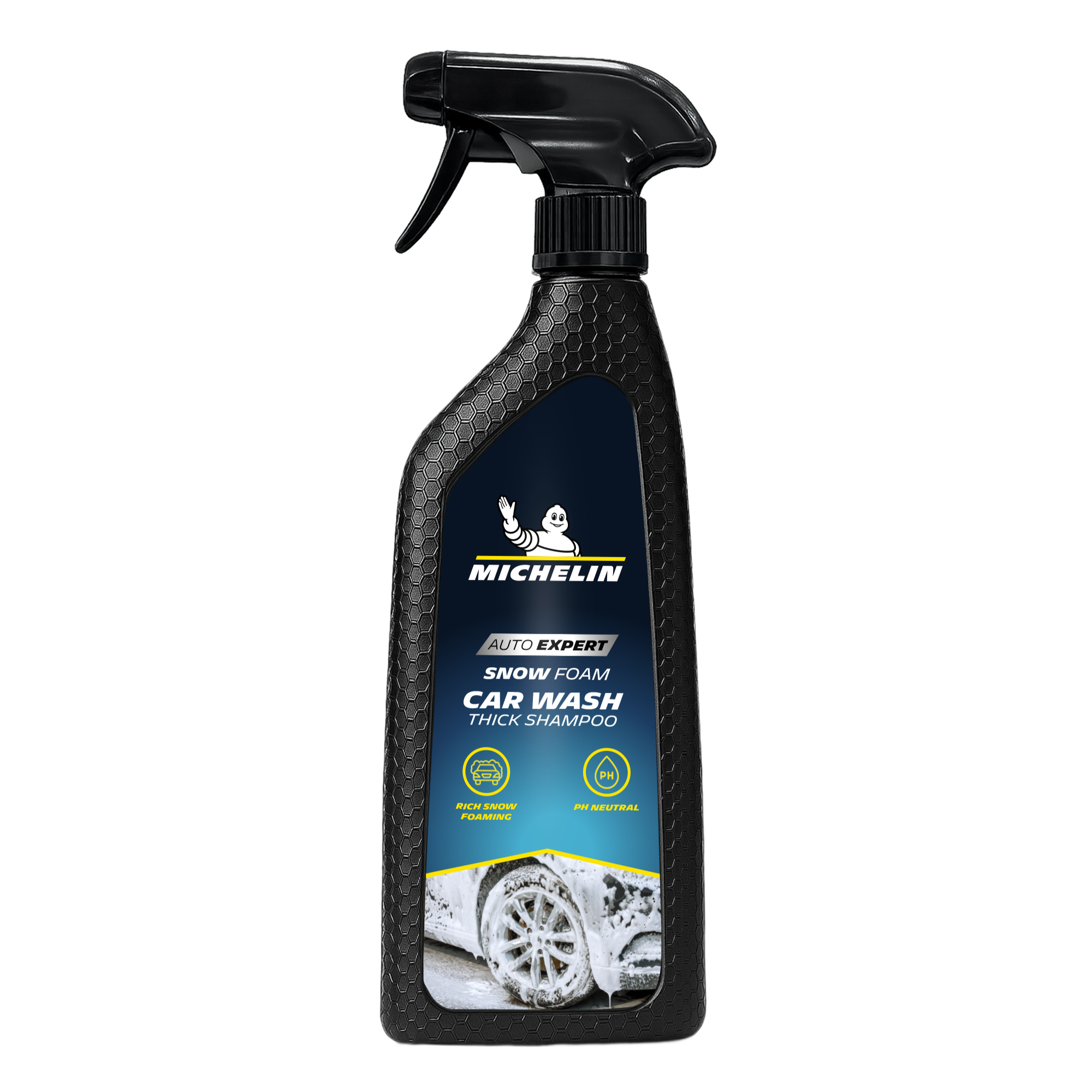
Dedicated car shampoo is formulated to lift dirt while leaving protection intact, and it provides lubrication — a slick layer between your mitt and the paint that lets grit release rather than drag. That lubrication is doing real work, which is why washing with plenty of suds matters more than most people think.
Browse the Michelin exterior care range for shampoo and wash products.
Choosing the right microfibre
Microfibre is not one product. The number that matters is GSM — grams per square meter — which describes the density of the fabric, and different densities do different jobs.
- Lower GSM, larger size — general washing, wheels and less delicate work. The MICHELIN 350 GSM 40x40 cm twin pack suits this.
- Higher GSM — drying and final buffing, where absorbency and plushness protect the paint. The MICHELIN 500 GSM 30x30 cm double-sided twin pack is designed for this: super absorbent, lint-free and scratch-free.
- Dedicated glass cloth — keep one towel exclusively for glass. Wax and polish residue transferred from a paint towel is what causes streaking on windows.
Colour-code them or keep them in separate bags. A towel that has touched the lower bumper should never touch the bonnet.
How to look after your microfibre
This is the step that quietly ruins good towels.
Wash microfibre separately from cotton — cotton sheds lint that embeds permanently in the fibres. Use a mild, non-biological detergent. Never use fabric softener: it coats the fibres and destroys the absorbency that makes microfibre work in the first place. Never use bleach. Air dry, or tumble on the lowest heat setting, because high heat melts the fibre tips and turns a soft towel into a mildly abrasive one.
Any towel you drop on the ground is finished for paint use. It picked up grit the moment it landed. Demote it to wheels or the engine bay.
Drying without marks
More scratches happen during drying than during washing, because people are tired by then and the lubrication is gone.
Don't let the car air dry — in most of India that leaves hard water mineral spots baked onto the paint. Use a high-GSM towel and blot or draw it gently across the panel rather than scrubbing in circles. Change to a dry towel as soon as the first one is saturated; a soaked towel drags instead of gliding.
When to wash, and when not to
Never wash in direct sun or on hot panels. Shampoo and water dry on the surface before you can rinse them off, leaving spots and streaks that are harder to remove than the dirt you started with. Early morning or evening, in shade, is the right window.
The short version
- Never wipe a dry, dusty car — rinse first or use a proper duster.
- Two buckets: one shampoo, one rinse. Rinse the mitt between panels.
- Top to bottom, separate cloth for the lower sections and wheels.
- Car shampoo, never dish soap or detergent.
- Match the towel to the job, and keep one dedicated to glass.
- No fabric softener, no bleach, no high heat when laundering microfibre.
- Dry with a plush towel — don't leave the car to air dry.
- Wash in shade, never on hot panels.
Michelin car care products in India are supplied by Axon Lifestyle, the official Michelin Lifestyle licensee. Explore the microfibre towel range or the full Michelin car care range in India.